7407
7407
Ally Course Report Overview
Ally's Course Reports can help you to get a big-picture view of how accessible your course content is. Then, you can drill down into the specifics to see which types of content are getting good accessibility scores and which are scoring poorly and may need more attention. Ally can show you which files need remediation, offer options for where to start, and guide you through the process of making those files more accessible.
How to access your Ally Course Report
Ally's Course Report feature is installed but is not automatically enabled in course's navigation menu, so before you access it for the first time, you will need to click into your Canvas course and manually enable the Ally Course Report item on your course's navigation menu. You will need to do this in every course where you wish to view your Ally Course Report.
Once you have enabled Ally Course Reports in your courses, you will be able to access them by following these steps:
- Log in to FSU's Canvas.
- Click into the course whose report you want to view.
-
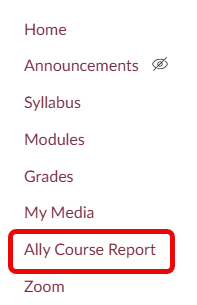
Select Ally Course Report on the course navigation menu.
Using the Ally Course Report
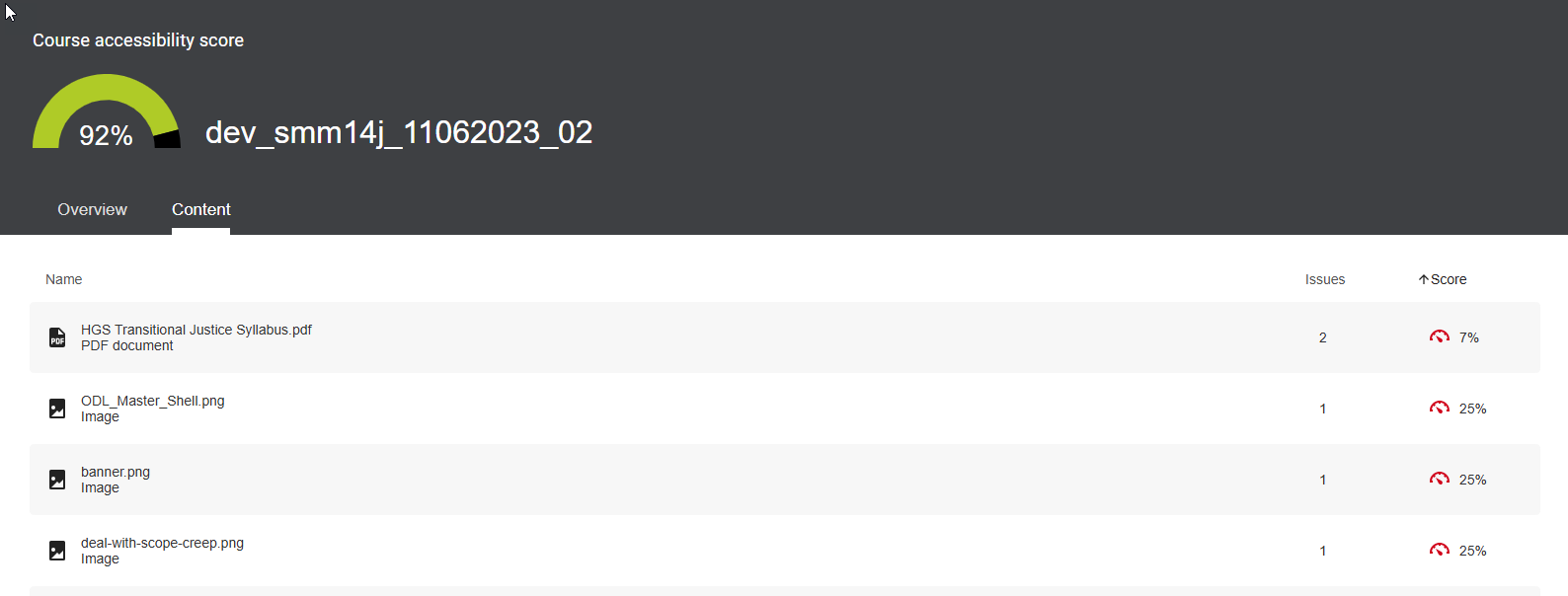
Your course report keeps your accessibility score visible at all times and is divided into two tabs: Overview and Content. When you first click the Course Report, it will always default to the Overview tab.
Note: The screenshots below do not contain real data and are provided for illustrative purposes only.
Accessibility Score
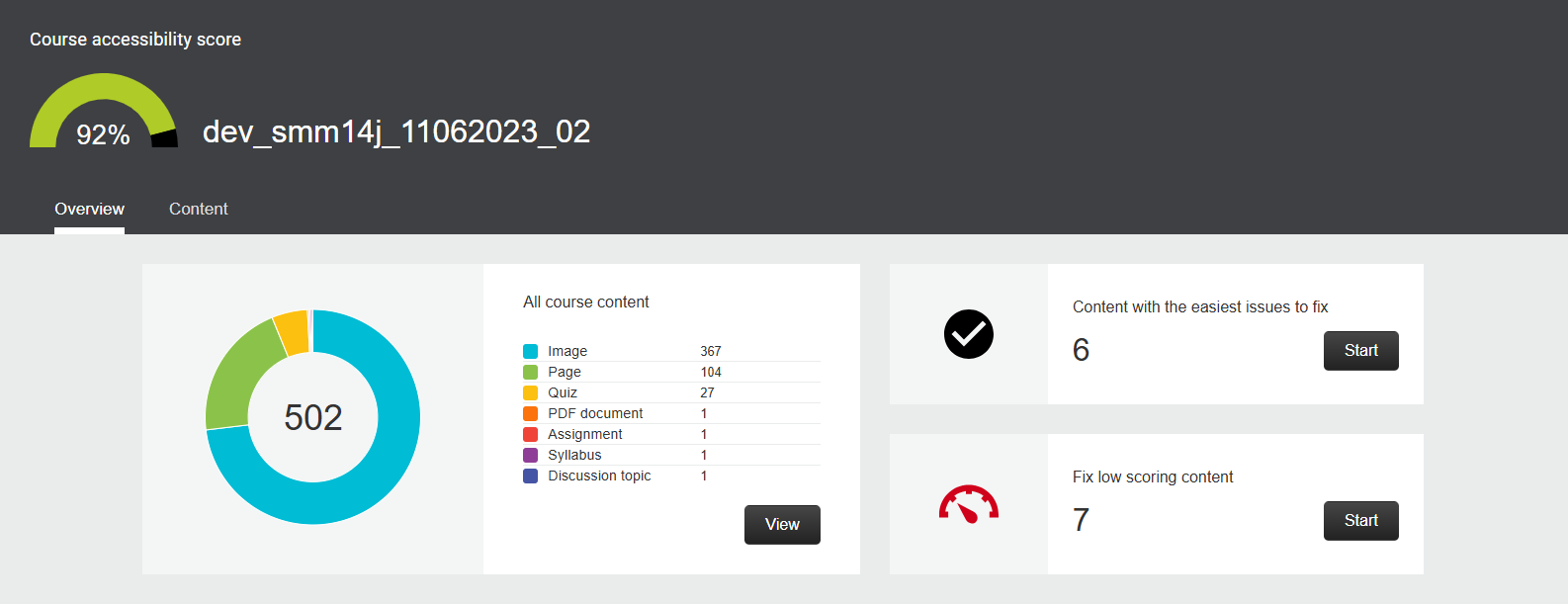
The accessibility score appears in the upper-left corner of the page and shows your course's overall accessibility rating. Scores range from "Low" to "Perfect", and you can find Ally's explanation for each score below*:
- Low (0-33%): This score means that your course needs help as Ally has flagged severe accessibility issues.
- Medium (34-66%): This score means that your course is somewhat accessible, but Ally has flagged some accessibility issues that need improving.
- High (67-99%): This score means that your course is almost fully accessible - most things are accessible, but a few more improvements are possible.
- Perfect (100%): Congratulations! This means that while further improvements may be possible, Ally has not found any accessibility issues in your course.
*To meet accessibility standards updated by the U.S. Department of Justice for Title II of the Americans with Disabilities Act (ADA) and effective April 24, 2026, digital course content must meet the Web Content Accessibility Guidelines (WCAG) Version 2.1 Level AA technical standard. Like all tools, Ally is limited in what it checks and analyzes. While your Ally score is helpful for identifying and addressing inaccessible content, a 100% Ally score is not a substitute for understanding and applying the WCAG 2.1 AA technical standard and does not guarantee a 100% accessible course.
Overview tab
The Overview tab contains a dashboard that visually displays all the content types in your course, the content items that are easiest and fastest to fix, and the items that received the lowest accessibility scores. Below this dashboard is the list of remaining accessibility issues in your course. If this looks like a long list, don't worry; Ally will help you to decide where to start so that making improvements will be less overwhelming.
All Course Content Graph
The All Course Content graph groups your course content together by type to show visually which types of content you have and how much of each type of content is present in your course.
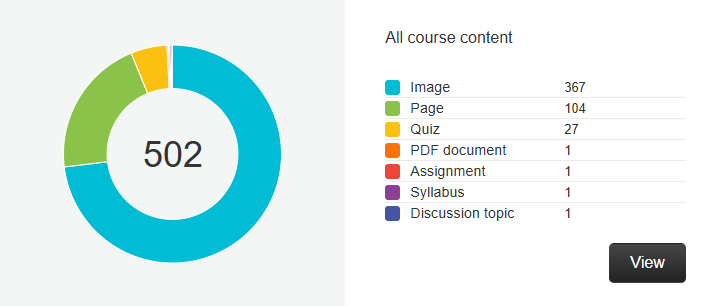
Ally checks the following content in your course:
-
Files uploaded into your Canvas course:
- PDF (See Ally's PDF Remediation guide and Accessibility Checklist for more information on the specific criteria that Ally looks for.)
-
Office file types
- Microsoft Word (.doc, .docx)
- Microsoft PowerPoint (.ppt, .pptx)
- OpenOffice/LibreOffice files
- Uploaded HTML files
- Image files (.jpg, .jpeg, .gif, .png, .bpm, .tiff)
- YouTube videos embedded in course pages
-
Content created within Canvas via the
Rich Content Editor:
- Announcements
- Assignments
- Discussion Topics
- Canvas Quiz descriptions
- Syllabus pages
- Course Content pages
Clicking the black View button will take you to the Content tab, which displays a list of all your course content.
Deciding What to Fix
If you're not sure where to start improving the accessibility of your course content, we recommend these quick and easy fixes. Then, once you're comfortable with those fixes, try moving on to either the easy fixes listed in your Course Report or the items that need the most attention, as indicated by their low scores. The option you choose may depend on how comfortable you feel with accessibility best practices and principles. Simply press the black Start button to select the option you want to pursue. On the next page that loads, simply click on a specific row to launch the instructor feedback panel to fix the issues in that content item.
If you're feeling overwhelmed and have never remediated your course content before, we strongly recommend starting with our list of quick and easy fixes. This gives you a chance to get comfortable with some helpful adjustments and avoid overwhelm while fixing your content. Then, as you feel more and more comfortable with Ally and fixing accessibility issues, progress on to the other easy fixes identified by your Course Report and the lowest-scoring items that likely need more substantial fixes.

Remaining Issues
Below the overview dashboard, you will see a list of remaining accessibility issues in your course content. This essentially groups your course content by the types of issues present and lists accessibility issues in order of priority, from severe to minor. To determine the severity and priority of each issue listed, Ally considers the number of students affected, the frequency of occurrence, and the accessibility score for each issue. Ally categorizes accessibility issues into three tiers:
- Severe: These issues require the most attention because they present the greatest risk to accessibility.
- Major: These issues are not severe, but still have a significant impact on accessibility, and so require attention.
- Minor: These issues do not present mission-critical accessibility issues, but should be considered in order to improve your accessibility score.

You can simply click on an issue row to view a list of all your course content that exhibits that issue. Then select a specific content item to launch the instructor feedback panel and fix the issue.
If you want to use this list to start working through accessibility fixes instead of the low-scoring vs. easy fixes approach previously discussed, then it is best to start with the items at the top of this remaining issues list, as those have the greatest impact on your course content accessibility.
Content tab
If you wish to see an itemized list of all your course content with the number of accessibility issues and accessibility score for that item, go to the Content tab.